
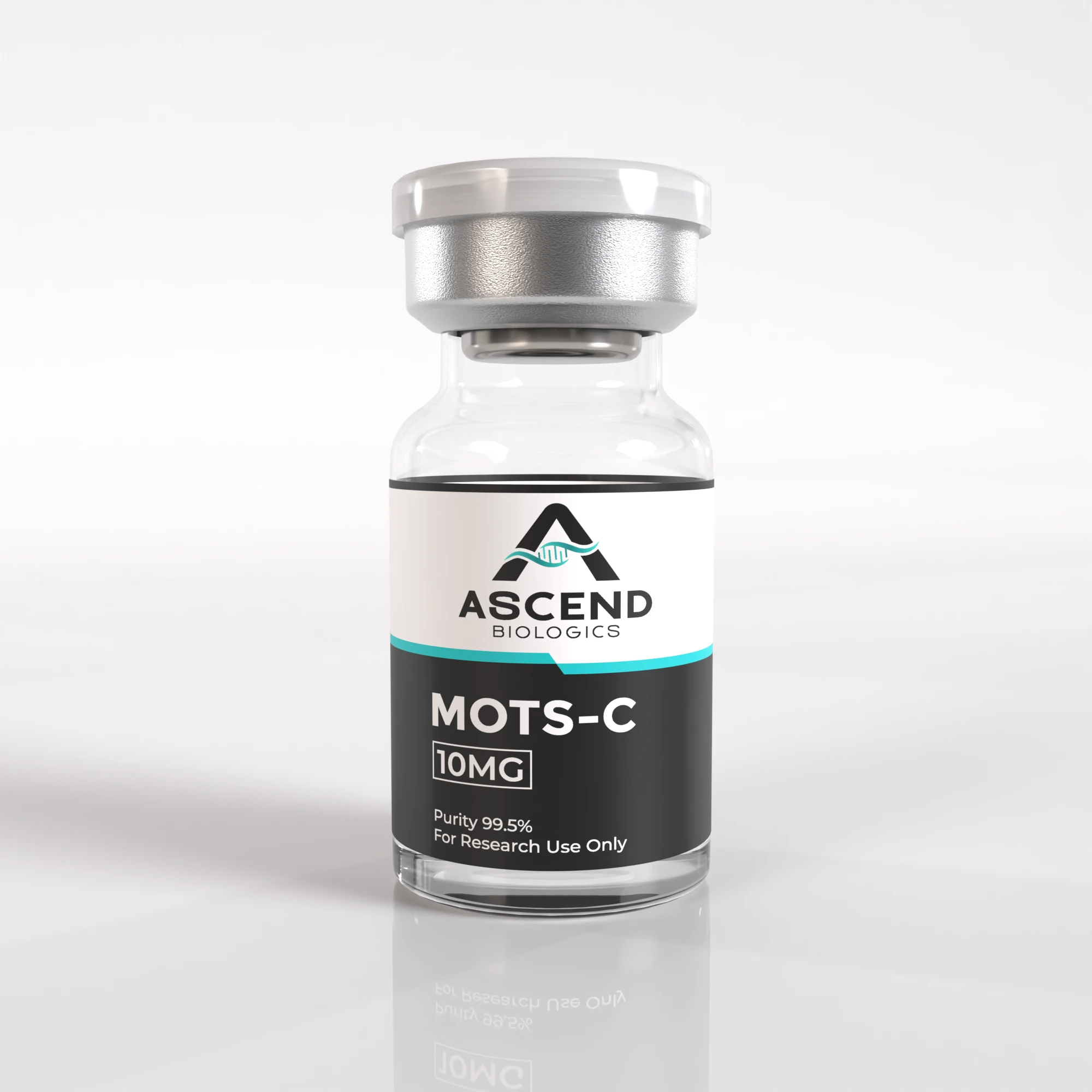

MOTS-C
MOTS-C (Mitochondrial Targeting Optimization Sequence-C) is a synthetic peptide derived from mitochondrial-associated proteins, designed for advanced biochemical and cell biology research applications. This product is intended for use in scientific investigations, not for therapeutic or consumer applications.
Research Context
MOTS-C has emerged as a promising peptide of interest due to its mitochondrial targeting and potential functional analogs to mitochondrial peptides such as mitochondrial-targeted antioxidant peptides (MTAs). Research suggests that MOTS-C may influence mitochondrial biogenesis, cellular energy metabolism, and stress response pathways, though its full mechanistic role remains under active study. Its structure—comprising hydrophobic and polar amino acid residues—enables membrane penetration and intracellular delivery, making it valuable for experiments probing mitochondrial dynamics and signaling.
Research Overview
MOTS-C has been investigated in a range of preclinical models for its potential to modulate mitochondrial function, including:
- Influence on reactive oxygen species (ROS) production and oxidative stress responses
- Effects on mitochondrial membrane potential and ATP production
- Investigations into autophagy and cellular homeostasis
- Exploration of metabolic reprogramming under stress conditions
Early studies have highlighted its ability to cross cellular membranes efficiently, suggesting utility in systems requiring targeted mitochondrial interventions. However, definitive conclusions require further rigorous experimentation within controlled academic or industrial research environments.
Key Research Focus Areas
- Mitochondrial Targeting Efficiency: Evaluation of MOTS-C’s ability to localize within mitochondria compared to endogenous mitochondrial peptides, influencing experiments on mitochondrial dynamics, bioenergetics, and protein import.
- Biochemical Signaling: Investigation of downstream signaling cascades triggered by MOTS-C, including interactions with mitochondrial receptors, kinases, or transcription factors (e.g., PGC-1α) that regulate cellular energy metabolism.
- Stress Response Mechanisms: Examination of how MOTS-C modulates oxidative stress pathways, such as Nrf2 activation or mitochondrial chaperones, under conditions of metabolic or environmental stress.
- Comparative Functional Analysis: Contrasting MOTS-C’s effects with established mitochondrial peptides (e.g., TM201, MTDR-1) to elucidate structural-activity relationships and specificity in mitochondrial functions.
- Cellular and Tissue-Specific Effects: Assessing MOTS-C’s activity across diverse cell lines or tissues (e.g., muscle, neurons, immune cells) to identify context-dependent effects on mitochondrial function and metabolism.
Safety and Compliance Notice
This product is intended solely for use in academic, industrial, or pharmaceutical research settings under the supervision of qualified personnel. MOTS-C is not approved for human or animal consumption, therapeutic purposes, or any application outside of controlled research environments. Proper handling, storage, and disposal procedures must adhere to institutional biosafety guidelines. The potential for unintended biological effects or toxicity remains speculative and requires thorough investigation in accordance with ethical and regulatory standards.
For research use only. Not for human or animal consumption.
| Size | 10MG, 40MG |
|---|



Reviews
There are no reviews yet.